Japanese with Anime

Wednesday, February 28, 2018

dakimakura 抱き枕

In Japanese, dakimakura 抱き枕 means literally a "hug pillow," in the sense of a pillow made for hugging. In English, the term is synonymous with anime body pillow, because a dakimakura is typically a body-sized pillow featuring an anime character on its cover.

This is also known as a "daki" in English, plural: "dakis."

A Nyaruko ニャル子 dakimakura 抱き枕.
Anime: Haiyore! Nyaruko-san 這いよれ!ニャル子さん (Episode 9)
Tuesday, February 27, 2018

正 for Counting (Japanese Tally Mark)

In Japanese, 正, the kanji used in words like tadashii 正しい, "correct," "right," is sometimes used as a tally mark, for counting stuff, e.g. how many goals a team scored, how many days passed, etc., mainly because the kanji has five strokes, so every 正 written down means 5, e.g. 正正 means 10, or it could be part of a word like seisei-doudou 正正堂堂, "fair and square."

Japanese tally marks written on a paper.
Anime: Hyouka 氷菓 (Episodes 12, 13, 16, Collage)
  • Context: tally marks conserve energy because you don't need to erase them.
Monday, February 26, 2018

FranXX Numbers to Names Explained

So, this season there's an anime called Darling in the FranXX (darifura ダリフラ), where the main characters are children product of some nefarious sci-fi utopia thingy. Such children are nameless, referred normally by codenames, which are just a few digits. Except that one of these characters, Hiro, used the numbers to come up nicknames for his nakama. The question is: how it works?

Why is 015 Ichigo, 016 Hiro, 056 Gorō, 196 Ikuno, 214 Futoshi, 326 Mitsuru, 390 Miku, 556 Kokoro, 666 Zorome, and 703 Naomi? What would be zero-two's nickname? And is there a meaning behind the names of the adult characters Nana and Hachi?

(there's a chart at the bottom if you wanna skip.)

Update: added the children of episode 13.
Sunday, February 25, 2018

Words Spelled Using Numbers

In Japanese, sometimes words are spelled using numbers. A sort of goroawase 語呂合わせ wordplay originally used in pager codes.

For example, 39 mean "thank you," 893 means yakuza ヤクザ, 4649 means yoroshiku よろしく, 084 means ohayo おはよ, 0833 means oyasumi おやすみ, 3470 means sayonara さよなら, and so on.

A pocket bell showing the pager code 8451, ha-yo ko-i ハヨコイ, meaning "come quickly," hayaku koi 早く来い.
Anime: Bishoujo Senshi Sailor Moon SuperS, 美少女戦士セーラームーンSuperS (Episode 143, 天馬を信じる時!4戦士の超変身)

Words With Alphabet Letters

Since I've posted a bunch of these already, here's a list of Japanese words containing English (Latin) alphabet letters, and the respective posts which talked about them. (in no particular order)

Some of these are wasei-eigo, meaning they're made up in Japan but out of English words. Some of these are abbreviations used in English too which I included because why not.

Note that since these terms are used in Japanese, the letters are pronounced in Japanese too. See katakanized English letters for how to pronounce them.

OVA
Original Video Animation. (wasei-eigo.)
Anime that's originally sold on VHS, videotape, discs, instead of airing on TV.

ONA
Original Net Animation. (wasei-eigo.)
Anime originally streamed instead.

OAD
Original Animation Disc. (wasei-eigo.)
Anime originally bundled with manga volumes as a bonus disc.

NEET (niito ニート)
Not in Employment, Education or Training.
(not wasei-eigo, but used mostly in Japan, originally from UK, it seems.)

NG. (enujii エヌジー)
Not Good. (wasei-eigo.)
(can't air on TV, "triggers me," etc.)

English Numbers in Katakana (List)

For reference, the names of the numbers in English and their Japanese katakanizations.

These are seldom used in Japanese.

See Japanese numbers for the normal numbers used in Japanese.

Some of these words contain rather unusual diphthongs to pronounce English correctly from a Japanese perspective. They're so unusual that I'm not sure if there's a standard romaji for them.

English numbers in katakana: ゼロ, ワン, ツー, スリー, フォー, ファイブ, シックス, セブン, エイト, ナイン

0. Zero.
zuirou, zero
ズィロウ, ゼロ
(zuirou is more accurate, but zero is more common.)

1. One.
wan
ワン

2. Two.
touu, tsuu
トゥー, ツー
(touu is more accurate, but tsuu is more common.)

3. Three.
surii
スリー

English Alphabet Letters in Katakana (List)

For reference, a list of the names of the English alphabet letters (ABC's) their respective katakanizations. Note that the pronunciation in romaji often doesn't match what you'd expect from English, since, well, it's not English, it's the romaji of the katakana.

See the Japanese alphabet, if you're looking for an overview of the Japanese characters.

The English alphabet letters in katakana: エイ, ビー, シー, ディー, イー, エフ, ジー, エイチ, アイ, ジェイ, ケイ, エル, エム, エヌ, オー, ピー, キュー, アール, エス, ティー, ユー, ヴィー, ダブリュー, エックス, ワイ, ゼッド

A
ei
エイ

B (bee)
bee, bii
ベー, ビー

C (cee)
shii, suii
シー, スィー

Wednesday, February 21, 2018

nonke ノンケ (LGBT Slang)

In Japanese, nonke ノンケ means "straight," as in a "heterosexual" person. It's an LGBT slang.

It's the katakanization of "non" in English, as in "not something," non ノン, and the ke ケ part comes from ki 気, which means a lot of things, but in this case it'd be like "intention." In order words: someone who is nonke is someone who does "not feel like it," sono ki ga nai その気がない.

The word nonke is usually written with katakana, but it may also be written with kanji as nonke ノン気, not to be confused with nonki 暢気, which means "carefree."

Since nonke is a slang it's not always used to say "heterosexual (person)" in Japanese, the more official way would be iseiaisha 異性愛者. It's easy to guess what this word means, given the meaning of its kanji literally spell "different-sex-love-person." To say "heterosexuality" in Japanese, the term would be iseiai 異性愛. (this is the same i as in isekai 異世界, by the way)

In fiction, among the shipping labels BL (boys love), GL (girls love), etc. NL is sometimes said to stand for "nonke love," nonke rabu ノンケラブ, i.e. "straight love."

Types of Seme & Uke

Here's a list of the types of seme and uke, which were originally part of another post, but the list is so disturbingly long it just makes more sense to put it in its own post.

Usage
Seme vs. Zeme
Non-BL labels

sou uke / sou seme
heibon uke / sasoi uke / osoi uke
do-S, do-M / kichiku seme / kenage uke
hetare seme / heppoko seme

kuuru seme, kuuru uke
oyaji uke, oyaji seme

oresama seme, oresama uke
wanko uke, wanko seme

koakuma uke / bitch uke
hime uke / joousama uke / tsukushi seme

otokomae uke / otome uke / macho uke
josou seme / mujaki seme / kawaii seme

nonke seme / yoko seme

toshiue uke, toshishita seme
toshiue seme, toshishita uke

gekokujou

riba, kotei
seme x seme, uke x uke
homo yuri
Sunday, February 18, 2018

nenabe ネナベ (Girl with Male Online Avatar)

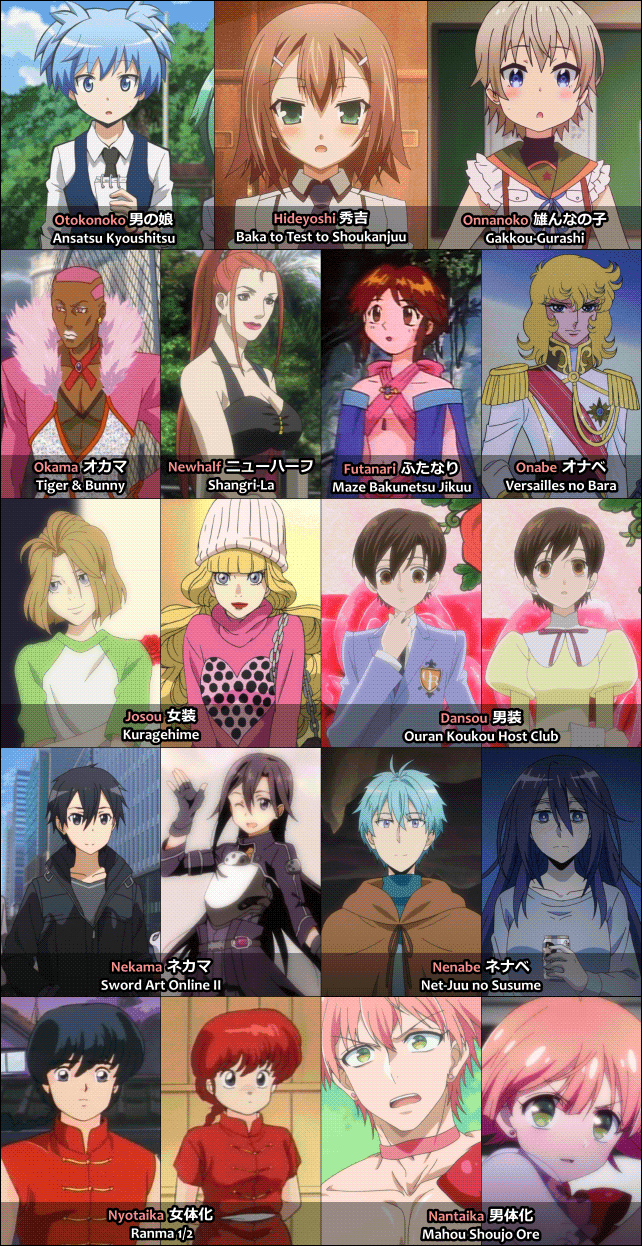
In Japanese, nenabe ネナベ means a girl with an online male avatar, e.g. a woman that plays a male character in an online game, MMORPG, etc. It's an abbreviation of netto nenabe ネットネナベ, "internet onabe," onabe オナベ being the female counterpart of okama オカマ. The male counterpart of nenabe is nekama ネカマ.

Morioka Moriko 盛岡森子 and her male online avatar, Hayashi 林.
Left: Morioka Moriko 盛岡森子
Right: Hayashi
Anime: Net-juu no Susume, ネト充のススメ (Episodes 3, 2)
  • Context: Moriko and her male avatar, Hayashi.

nekama ネカマ (Boy with Female Online Avatar)

In Japanese, nekama ネカマ is a guy who plays as a girl online in a MMORPG, or has an online female avatar or identity. It's an abbreviation of netto okama ネットオカマ, literally "internet okama." The opposite is called a nenabe ネナベ, from onabe オナベ.

Kirigaya Kazuto 桐ヶ谷和人, and trap Kirito キリト, a.k.a. Kiriko キリ子.
Left: Kirigaya Kazuto 桐ヶ谷和人
Right: "Trap Kirito キリト", a.k.a. Kiriko キリ子
Anime: Sword Art Online II, ソードアート・オンラインII (Season 2) (Episode 8, Collage)
Saturday, February 17, 2018

onabe お鍋, オナベ, nabe 鍋 (Stew, Pot, LGBT-Related Slang)

In Japanese, onabe お鍋 means multiple things. It's a sort of "cooking pot" used to make stew, a "saucepan." it's also called nabe , without the o~ お~ prefix. It can also mean "stew," which is cooked in the pot. When spelled with katakana, onabe オナベ is a LGBT-related slang for masculine women, lesbians and trans men, sometimes considered pejorative.

Example of shiitake しいたけ mushrooms with "decorative cuts," kazarigiri 飾り切り.
Anime: Mawaru Penguindrum, 輪るピングドラム (Episode 21)